NDIS Invoicing: What You Need to Know
NDIS invoicing is tricky. Many providers get it wrong. When you bill the NDIA, you need to follow their rules exactly. If you don't, your invoice gets rejected. That means no payment. That means cash flow problems.
What NDIS Invoicing Actually Means
NDIS invoicing is different from normal invoicing. When you bill a regular client, you send an invoice and they pay you. NDIS is not like that.
With NDIS, you must follow strict rules. The National Disability Insurance Agency (NDIA) controls the money. They decide what you can charge. They decide how you must bill them. You don't get to make up your own process.
Every invoice you send must match the participant's plan. The plan says what support they can get. It says how much money they have. It says what types of support are approved. Your invoice must fit inside these rules.
You need to show exactly what services you provided. You need to show when you provided them. You need to show how long they took. You need to show how much you charged. The NDIA wants itemised invoices. That means breaking everything down into small pieces.
This creates a lot of extra work. Small providers often struggle because many still rely on spreadsheets, paper timesheets or disconnected systems. Manual invoicing processes increase the risk of errors, delays and rejected claims. As digital invoicing and stronger compliance requirements continue to emerge across the disability support sector, providers need systems that improve accuracy, tracking and documentation from the start.
Common Mistakes That Cost You Money
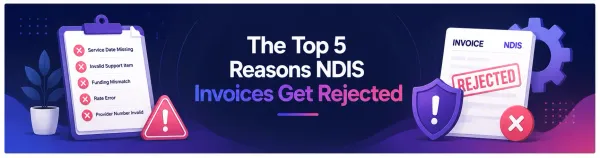
The biggest problem is documentation errors. The NDIA rejects invoices that don't meet their standards. When your invoice gets rejected, you don't get paid. You have to fix it and resubmit. This delays your cash flow.
Here are the most common mistakes:
Wrong participant details
You put in the wrong participant ID number. You spell their name wrong. You get their date of birth wrong. The NDIA system can't match your invoice to their file. Rejected.
Services don't match the plan
The participant's plan says they get two hours of support per week for meal preparation. You invoice for five hours. Rejected. Or you invoice for support that isn't in their plan at all. Rejected.
Timesheet problems
Your support worker says they worked ten hours. But their timesheet shows eight hours. You invoice for ten hours. The NDIA checks and finds the discrepancy. Rejected.
Missing paperwork
You submit an invoice but don't include the timesheet. You don't include the support worker's details. You don't include proof of what was delivered. Rejected.
Billing outside the budget
The participant's plan has a set amount of money for each type of support. They have five hundred dollars for core supports. You've already invoiced four hundred dollars. You try to invoice another two hundred dollars. That's over budget. Rejected.
Wrong rates
Different support workers have different rates. A support worker without qualifications charges less than one with qualifications. You bill the wrong rate. Rejected.
The problem gets worse when you manage lots of participants. One mistake per invoice might seem small. But if you're invoicing fifty participants, that's fifty potential mistakes. Many invoices get rejected. You spend all your time fixing problems instead of doing actual work.
How to Get It Right
The solution is to set up proper systems. You need a process that works every time.
Get the right software
Manual invoicing processes are becoming harder to manage as compliance expectations increase across the NDIS sector. Good invoicing software helps providers create consistent digital records, reduce administrative work and minimise billing errors before invoices are submitted.
The right system can automatically track participant budgets, validate shifts, maintain accurate service records and support compliant invoicing processes. It can also help providers prepare for the growing shift toward digital invoicing and stronger recordkeeping expectations within the disability support sector.
Use standard templates
Create a timesheet template. Create a service record template. Make sure every support worker uses the same template. Train them on what to write down. Don't let them make up their own format. When everyone does things the same way, mistakes drop dramatically.
Check your work before you send it
Don't send invoices that you haven't reviewed. Look at a sample of invoices every month. Make sure they meet NDIA standards. Fix problems before they become rejected invoices.
Keep detailed records
Save every timesheet. Save every service record. Save every email about the participant's plan. Keep these records for at least two years. If the NDIA ever questions an invoice, you need to prove what you did.
Understand each participant's plan
Read it carefully. Know exactly what support is approved. Know exactly how much money they have for each type of support. Track what you've invoiced so far. Make sure you never go over budget.
Train your team properly
Everyone who does billing needs training. Everyone who does support work needs to understand timesheets. They need to know what information matters. They need to know why accuracy is important.
What Happens When You Get It Right
When you set up good systems, things get much easier. Your invoices get approved first time. You get paid on time. Your cash flow stays healthy. You spend less time fixing problems. You can focus on actually delivering support.
Providers with good systems waste less time on administration. They have fewer rejected invoices. They get paid faster. They know exactly where they stand with each participant's budget. They can plan for the future.
Moving Forward
NDIS invoicing rules change sometimes. The NDIA updates their guidelines. Compliance expectations also continue to evolve as the sector moves toward more structured digital invoicing and documentation practices. Providers need to stay aware of changes, maintain accurate records and ensure their systems can support compliant invoicing processes over time.
Providers who continue relying on manual invoicing processes may find it increasingly difficult to keep up with growing administrative and documentation expectations. Moving to a modern invoicing and workforce management system helps reduce risk, improve visibility and create a smoother billing process for both providers and participants.
Remember that lots of providers struggle with this. You're not alone. But the providers who take invoicing seriously do better. They have fewer problems. They make more money. They have less stress.
NDIS invoicing matters. It's not exciting work. But it's the foundation of your business. Get it right and everything else becomes easier. Get it wrong and you'll spend all your time fixing problems instead of helping people.